Cypress Ambassador Spotlight: Darpan Shah
By Jessica Capuano Mora
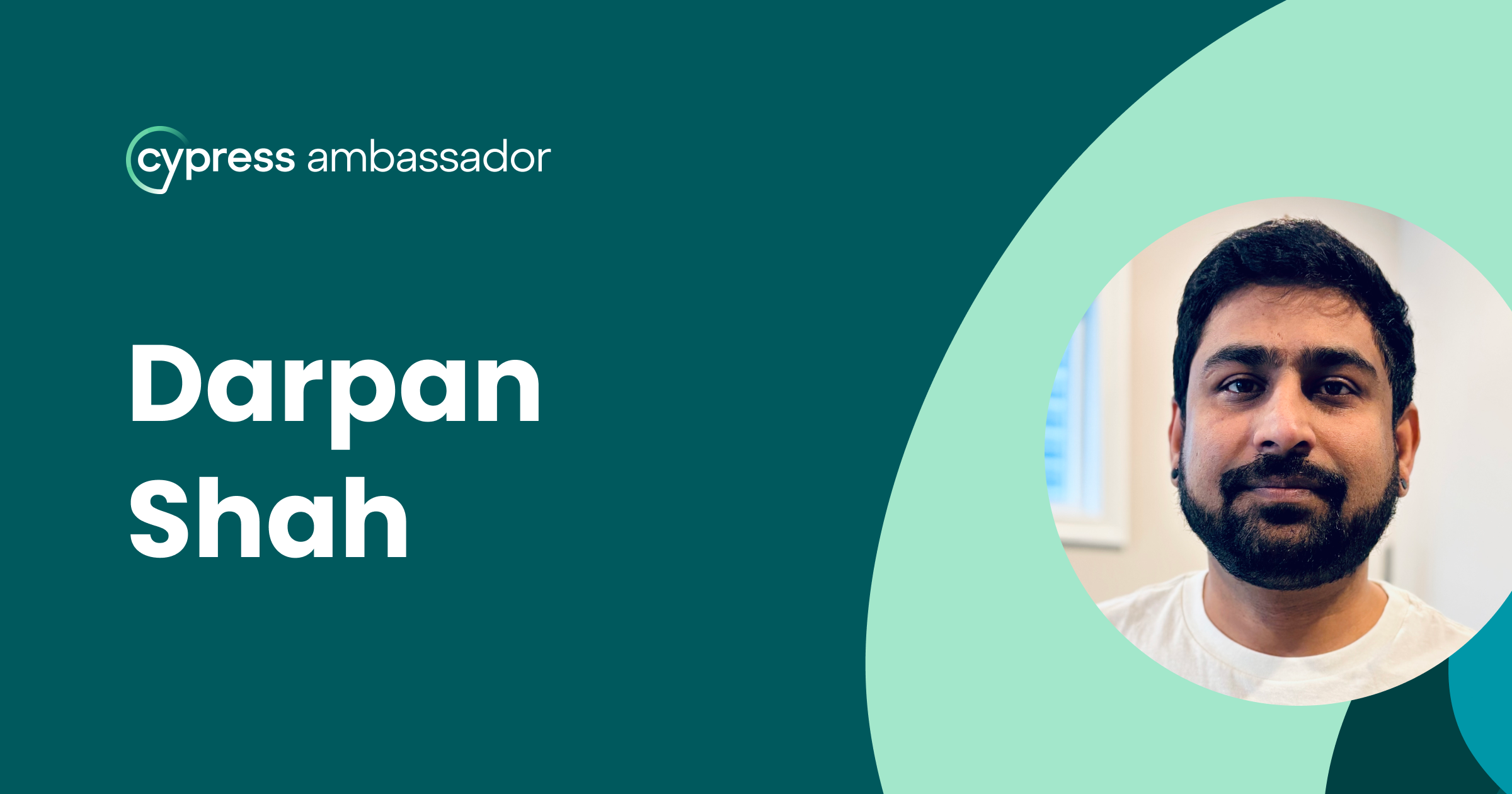
Welcome back to another Ambassador Spotlight! Each post in this series pulls back the curtain on the testers and builders driving the Cypress community forward, sharing how they got here, what keeps them going, and the lessons they've picked up along the way. Curious about the program itself? Learn more here.
This week, we’re highlighting Darpan Shah, who has spent years turning his Cypress experience into blogs, workshops, talks, and mentorship for anyone willing to learn. From the testing philosophy he believes in to what keeps him busy outside of work, there’s a lot to unpack. Read on to get the full picture.
What motivates you to be a Cypress Ambassador?
I’ve been an avid Cypress user for a long time and have always been passionate about sharing best practices, both within my organization and with the broader testing community.
Over the years, I’ve had the opportunity to work on some incredible projects, refining test strategies, improving automation workflows, integrating quality into CI/CD pipelines, making quality measurable and actionable, and helping teams scale their quality practices.
What motivates me most about being a Cypress Ambassador is the opportunity to take those experiences beyond my immediate teams and contribute back to the wider community.
I strongly believe in collaboration and continuous learning. Being part of the Cypress community gives me the chance to share what I’ve learned while also learning from other ambassadors and practitioners who are solving different real-world testing challenges.
Cypress has played an important role in shaping how I approach modern test automation, and I enjoy helping others unlock its full potential through talks, blogs, workshops, community discussions, and mentorship.
For me, being an Ambassador is also about giving back to a community that has helped me grow. Testing continues to evolve quickly, especially with AI becoming a bigger part of software development, and I enjoy being part of those conversations and helping shape what modern quality engineering can look like.
How do you currently help others that are either using Cypress or interested in using Cypress?
Within my organization, I’ve created documentation, examples, frameworks, and guidance to help teams adopt Cypress effectively. I’ve also coached and mentored engineers who were new to Cypress, helping them understand not just how to write tests, but how to design reliable and maintainable automation.
Outside of work, I share what I learn through LinkedIn articles, my blog at darpanshah.dev, talks, workshops, and community events.
I conducted a Cypress workshop, spoke at CypressConf 2024, and have also been part of the Cy.Pronauts program, where I’ve had the opportunity to engage with the community, exchange ideas, and learn from other Cypress experts.
Whether it’s through mentoring, sharing best practices, speaking at events, writing, or simply helping someone debug a difficult test, I enjoy making Cypress and modern test automation more approachable and practical for both testers and developers.
What is your favorite Cypress feature?
It’s difficult to choose just one. My favorites are cy.session(), cy.intercept(), and, more recently, Cypress Cloud MCP.
cy.session() is incredibly useful for improving execution speed. Instead of repeatedly going through expensive login flows, sessions can be restored between tests, which can make a significant difference when working with larger test suites.
cy.intercept() gives you powerful control over network traffic. Being able to observe, stub, modify, or validate API requests makes it much easier to test different application states and edge cases without always depending on backend changes.
More recently, I’ve been excited about Cypress Cloud MCP because it connects Cypress testing workflows with AI-assisted development. It can help close the loop between identifying failures, investigating them, triaging issues, and moving toward a fix. I also like the ability to bring information from multiple test projects together so teams can understand test health without manually jumping between different places.
There are many Cypress features I use regularly, but these three have had a particularly strong impact on how I build, optimize, and operate automated testing.
What is your favorite "Cypress Best Practice" and why?
The best practice I talk about most is being intentional about what you automate. More tests do not automatically mean better quality.
I often think about automation using the 80/20 principle: a relatively small number of well-designed tests can provide a large amount of confidence. Instead of creating hundreds of tests that add execution time and maintenance overhead, I prefer focusing on critical user journeys, high-risk areas, and scenarios that are most likely to catch meaningful regressions.
I also strongly believe in keeping tests simple and readable. A good automated test should make its purpose obvious to the next person who reads it.
Test isolation is another important principle. Each test should be able to run independently without depending on another test to put the application into a particular state. This improves reliability, enables parallel execution, and makes failures much easier to investigate.
For me, effective automation is about signal over volume: test what matters, keep it simple, and build tests that teams can trust.
Outside of work, what are your favorite things to do (hobbies, passions, etc.)?
Living close to the Rocky Mountains means I’m fortunate to have some incredible places to explore.
During the summer, I love getting outdoors, discovering new hiking trails, taking photographs, and going on long drives.
These days, though, a lot of my time outside of work is spent with my family and chasing after my son, who keeps me on my toes and makes sure there’s never a dull moment!
What is one professional milestone you are proud of?
Becoming a Cypress Ambassador is definitely one of the milestones I’m most proud of.
It’s rewarding to be recognized for something I genuinely enjoy doing and to have an opportunity to contribute back to a community that has played an important role in my own growth.
Speaking at CypressConf 2024 was another special milestone. Sharing experiences with the Cypress community and hearing how other teams approach quality and automation reinforced how much we can learn from each other.
More broadly, I’m proud of the progression from simply writing automated tests to thinking about quality at a much larger scale: how we make it measurable, how we integrate it into delivery pipelines, how we give developers faster feedback, and how we build confidence in software across an organization.
There is always something new to learn, and that continuous progression is one of the things I enjoy most about working in quality engineering.
For new users - what is the best way to "get started" with Cypress?
One of Cypress’s biggest strengths is how approachable it is for someone getting started.
I recommend beginning with the official Cypress documentation and Real World App examples. Start with a few simple tests, understand how Cypress interacts with the browser, and get comfortable with concepts such as queries, retries, network interception, and test isolation.
One thing I would encourage new users to avoid is immediately trying to build a large framework. Start small. Automate one meaningful user journey, understand why the test works, learn how Cypress handles synchronization and application state, and gradually build from there.
Understanding the fundamentals will take you much further than simply copying patterns from an existing framework.
What is your favorite quote or saying?
“Automation is about building confidence in quality.”— Darpan Shah
It’s something I strongly believe in. The goal of automation isn’t simply to execute more tests. It’s to give developers, testers, and organizations the confidence to make changes and deliver software knowing that the things that matter most are continuously being validated.